3 March 2013

Aiming for an 'A' - Part 2. People Problems.

My 'A' is bearing down on me, and I am feeling the pressure.  Although the Assessment day is in May, I have rather a lot of things happening between now and then, and I still have a lot of work to do before I have a panel I'm satisfied with.

Photographing bells was never going to be easy, but it IS interesting.  I now have pictures of bells being produced, bells in towers (from above, alongside and below), churches, ropes and ringing chambers.  But I am struggling to get across the 'people' aspect.  It's a part of the panel of critical importance, because bells have been rung by hand in this country for over 400 years, and they still are.  There are some challenges for me in getting people shots, some of which are:

I am not a regular 'people' photographer...

Ringing chambers usually have horrible lighting and flash is not exactly welcome when a band is ringing.

Bells create movement in towers.  Not the obvious movement - ie. the bells swinging - but movement of the entire tower!  Yes, lots of towers move as several hundredweight of bells are rung inside them.  This makes long exposures tricky...

Ringers are moving quickly as they ring, and hands or ropes frequently cover faces at the key shutter-pressing moments.

Access and angle for your shot is frequently difficult with limited options as to where you can safely be messing about with a camera.

Oh, and ringers often look extremely focused, which doesn't translate brilliantly in a photo.

A previous set of pictures of ringers got the comment 'they're all a bit blurred...' from our Tower Captain.  My carefully chosen slower shutter speed, specifically picked in order to blur the ringers' arms and thus show the movement clearly didn't achieve the desire objective.  This is part of the reason why I changed my approach, and set out to try to get some less obvious pictures of people ringing bells.

Here is an example:
This picture was taken in Devon.  The ringing chamber has a glass wall between it and the church. The glass reflected the stained glass behind me, the clear glass windows of the church can be seen beyond, and in between the band of eight ringers can just be seen.  I rather like this image - taken quite unplanned with a compact camera (Canon G11) when I heard the bells being rung while out for the day - but I am not sure it is ARPS material.

One noticeable change between preparing for my LRPS and my APRS panels is that for my 'L' I built the panel from pictures I shot as a regular part of my photography.  I photographed the things I liked and found interesting, and each time I caught an image I liked especially I would 'park' it in my LRPS folder on my computer, ready for review as part of my panel.  This approach resulted in a panel which I felt was a good reflection of 'my kind' of photography at the time of submission.  Three years on, I find my photography has changed, and so I think for me the advice to wait after the 'L' (& take time to enjoy it!) was wise.

For the ARPS I have had to be far more structured in my approach to producing the panel.  My statement of intent (SOI) has helped with this (blog post to follow!), and I have had to go out with much more specific photographic goals in mind.

I went on a ringing tour recently.  Ringing tours are common as bell-ringers like visiting new towers and ringing the bells they contain.  On this tour, twenty-two of us spent the day travelling from tower to tower and ringing, and I took my camera along with the specific aim of shooting people for my 'A'.

As the biggest 'ring' on this tour was eight bells, this meant that after a while the other ringers got used to me clambering around with a camera, and I ended up with some interesting shots.


At the moment, my shortlist includes just one of the resulting images, and I am still unsure that I have sufficient 'people involvement' in my shortlisted images folder - but at least I now have some to choose from.  I am about to send off some pictures for comment using the RPS's 'advice and guidance service' and I will post about the results in due course.

3 February 2013

Aiming for an 'A' - Part 1. Warning Flags.

As I wrote a series of posts about my path to obtaining my 'L' (or more properly my 'LRPS', meaning Licentiateship of the Royal Photographic Society) it seems to make sense to do the same again, now that I am aiming for my 'A'.  The 'A' in this case stands for Associateship, and is the next step up from the L.  When I say next step, I don't mean a tidy little couple-of-inches-high step, I mean a whacking great giant sized step.  The RPS says that the A is a big step up from the L, and they really mean it.  I suppose the up side is that this means that obtaining it will be some achievement.  The down side is that it is a jolly sight tougher than the L was, and THAT was not exactly a walkover.  However, I passed my L in 2010 - nearly three years ago, yikes - so now feels like the time to aim for the next level.  

So, last autumn I duly filled out the ARPS application form, and promptly ran into my first difficulty.  I didn't know which category my chosen subject matter fitted in.  So after quite a bit of um-ing and ah-ing, and several emailed conversations with Ben at RPS (who has the patience of a saint), I decided that I would be applying within the Professional and Applied rather than the Visual Arts category.  But I should've taken heed of the uncertainty I felt in trying to decide, as it was a big warning flag.  It showed I didn't know how I was going to approach the actual photographing of my topic as far as the finished style was concerned.

I had decided to submit a panel of images of doors and windows, as I have enjoyed photographing these for a long time.  I started working on this, but a niggly voice in my head was muttering that this was not the right decision.  I should've listened to that, too.  Another warning flag.  It showed I wasn't confident of my subject.


When I worked for my L I was very nervous, but I had a good idea of what I wanted to do, how I wanted it to look, and what my end objective was.  I was discovering that for my A, I was increasingly unsure of what I wanted to do, was confused about how I wanted it to look, and had no real idea of where I was going in terms of the final panel.  

And most discouraging of all, I didn't feel that the panel I was working on reflected who I am becoming as a photographer.  This was probably the biggest warning flag of all.  It showed I wasn't brave enough to reach forward out of my 'comfort zone'.

I finally took notice.  I booked to attend an Advisory Day.  

I attended an Advisory Day for my L too, and it was extremely useful.  So I was hopeful of some helpful insights this time.  As I walked from my car to the RPS HQ in Bath, I felt even more strongly that the panel I was working on wasn't the right one, and I already had an idea of what I wanted to do.  Before it even got to the point in the day when my prints were put up for comment, I knew for sure that my earlier uncertainties were well founded.  It was obvious that my partial panel was nowhere near strong enough.  The comments just confirmed it.


I came away knowing I needed to start again from scratch.  Although it meant discarding all the work I'd already done I was excited about my new idea.  If the advisory day had gone well I would probably have carried on with the same project, but the fact that it hadn't gone well gave me the chance to change my mind and start again.   It meant postponing my assessment date, but it also meant I was now working on a project I am passionate about, which I think is a bit unusual for a Distinctions panel, and which I have a clear objective for.

At last.

So now, here I am moving away from a panel of doors and windows (though I still enjoy photographing them), and I am busily putting together an offering on church bells instead.  Ah yes, church bells.  An obvious choice for a Distinctions panel...  This is going to be an even bigger challenge, but this time I'm loving it!  I KNOW this is the panel I want to present, and it will reflect who I am as a person as well as a photographer. 

The moral of this particular chapter of the story is:  If you're going to aim for an A, you need to know exactly what you are going to shoot, why you want to shoot it, and how you are going to approach it.

And you need a clear 'Statement of Intent'.  At the beginning.  More on that to come...


27 January 2013

The Challenge of Photographing Bells

This weekend I spent several hours photographing bells at St Margaret's Church, Hinton Waldrist.
So I thought I'd re-start my blog posting with a few comments on the joys and challenges of photographing bells.

St Margaret's is a pretty village church set in the Oxfordshire countryside, with a ring of six bells. Five are on one level, and one (the four - ie. the fourth of the six) is at the top of the tower, behind the clock.


At Hinton Waldrist the ringing chamber is on the ground floor, with the door at the end of the aisle.  So I started by photographing from the aisle back to the ringing chamber.  You can (just) see three sallies hanging down into the room.  The second picture is the reverse.  A 'ringers eye view' from inside the ringing chamber looking down the full length of the church.*

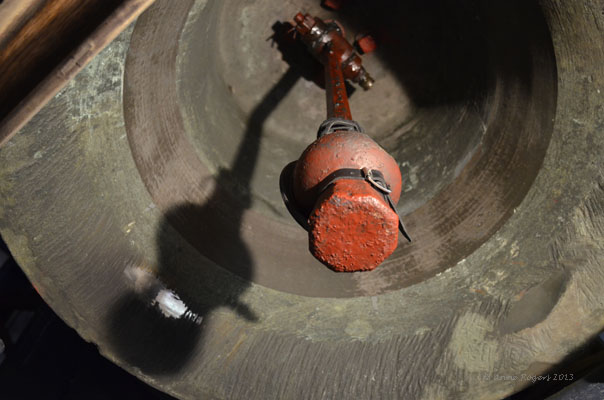
Some towers have quite a bit of space around their bells, and some don't.  Hinton's bells are fairly tightly packed in, and climbing up to the clock platform and the four means squeezing between the other bells.   Climbing two ladders brings you out below the main ring of bells.  In this tower, unlike many others, there's enough space to stand up beneath them, and I took this shot almost straight up into the mouth of the tenor.  


Taken without flash, the strong shadow is cast by light coming through one of the tower windows.  If you look at the lower end of the clapper, you will notice a buckle.  This is holding a muffle to the part of the clapper which strikes the bell.  You can see the silver wear mark where the clapper makes contact with the bell.  The muffle means the sound as the bell strikes on the left of the bell in the picture is muted or 'muffled'.  Because the other side of the clapper is not covered, as the bell swings back the clapper strikes the other side of the bell in the usual way, making the usual loud clang on the metal.  The result is known as ringing 'half-muffled'.  

Half-muffled bells are heard on remembrance day, and are rung for funerals and other memorial occasions.  The bells of Hinton were half-muffled because the tower captain, Dennis Leslie, recently died and his funeral and wake were accompanied by a lot of ringing.  However, after I photographed this, we removed all the muffles ready for the next day's Sunday morning ringing.

So, looking at the underneath of bells can be interesting.  For example, on the bell shown above, you can see the circle made by modern day bell tuning, and the deep scratches made by historical tuning which was done by chisel!

But the tops and outsides of bells are also fascinating, often bearing inscriptions and decorations which most people never see.   These fish, for example!


This is the ladder from which I took the picture above!


At the time, I had one arm wrapped through the rungs, only one foot on the ladder, and another bell directly behind me.  The camera was in one hand and the angle so awkward I had to press the shutter release with my thumb!  The ladder is so narrow and tight that I couldn't carry my camera up with me and had to pull it up after me on a rope!

This is the four, in solitary splendour at the top of the tower.  The bell is 'up' (the mouth of the bell pointing upwards) because we needed to access the clapper to remove the muffle, and this bell cannot be accessed from below.  


Bells are dangerous when they are 'up'**, so I was extremely cautious while moving near it.  Plus I was a long way up on a platform with some serious drops off of it:


This is looking down from the upper platform.  You can see two bells (just about), and the wheel and rope of the left hand one.  If you follow the rope down, you can see the hole through which it passes on it's way to the ringing chamber three floors below.

These are just a few of the photographs I took, and I hope they show a little of why I love to photograph bells.

I am currently working on a photographic project involving bells, so expect to hear more on the subject between now and May, which is 'crunch date'.

- - - - - - - - - - - - - - - - - - - 

*My favourite ringers eye view in this church was at a wedding for which I rang, when the bride and groom quite literally danced down the aisle after the ceremony!

** Even the small ones are heavy, the big ones are REALLY heavy. They move quickly, are very unforgiving and have seriously injured and sometimes killed people.  You do not mess about with bells.


20 January 2012

'Window Shopping' in Chester

This week I've been in Chester on business. As it happens, the person I was meeting there is also keen on photography. So in the evening, once the business stuff was concluded, we met up in Chester with our cameras and did a little window shopping on our way to dinner... I hadn't planned to concentrate on windows, but as you may know, I do like photographing doors and windows so I suppose it wasn't surprising that I ended up with several 'window shots'.

The first window to catch my eye was this one.


Who could resist such a fantastic display? Not me - and not my friend Jo...


The next one had a little less impact in terms of window dressing, but I liked the stepladder (I know - it takes all sorts).


Talking of steps, I also liked the steps at the side of the shop (the shop being in the Rows). The textures of the stone and brick appeal to me.


The last of my Chester windows was this one, a bit of a snatch shot because I liked the way the passer-by was looking into the window - but mostly I liked the red...


About an hour of spare time. Maybe half a mile of interesting architectural details. A small, light DSLR (Nikon D60) with a small, light lens (35mm). A friend with a D90. Result: some fun with photography for us both.


13 November 2011

We Will Remember Them


For those in Flanders fields we hold high the torch, and hold faith with those who died.
For those who've died elsewhere, we keep the flame alight for you too, and remember...

20 August 2011

Four Horses, Four Ways

Highnam Court Gardens, Gloucestershire. Very beautiful, and with lots of amazing wooden sculptures set throughout. One of my favourites is of four horses, created by Dave Bytheway to commemorate the visit of The Prince of Wales to the gardens in 2010. The entire sculpture sweeps upwards, but my picture concentrates on just two of the horses.

This is it, a balance of the wooden horses in their wooded environment.


But something about the colour range doesn't quite work for me. I'm not a big user of Photoshop, but I thought it might be fun to play about a little bit with this picture so I went to find a little help in the form of a manual.

I started with a conversion to black & white - didn't need the manual for that one!


Needs something else... Perhaps a bit of blurring of the trees, and some drybrushing of the horses:


Still not sure the horses stand out enough. Let's try something else:


This one did need some help from the book with as I wanted to create a kind of 'other worldliness' about the image.

Four ways of looking at some wooden horses. Hmm, perhaps I prefer the third version after all.

Which do you prefer?


3 July 2011

A Lumix in London

Last week I went to London for a conference. As I was carting around work kit, I naturally didn't take all my camera gear, but I did tuck my smallest camera away in my bag. (It's a Panasonic Lumix TZ6, if you're interested. I didn't get on with it at all well to start with, but I have learned to appreciate its strengths.)

As it happens I was very tight for time on the day, and as I was working I had no time for wandering off looking for photographic subjects. Luckily, the subjects turned out to be right in front of me.

The conference I attended was held in the British Medical Association's offices in Tavistock Square.

On my way out of the meeting room, I noticed the BMA symbols on the glass doors out into the courtyard and thought they might make for an interesting shot, as they explain visually what the building behind is all about. It helps that the BMA building is beautiful and photogenic, so provided something attractive as the backdrop!


In the courtyard were some benches. Nothing very exciting in themselves, but against the stone, with some nice curved windows and a suitably positioned small tree in a pot, there was another picture for my set. Shame the lighting was a bit flat, but you have to go with what you've got in these situations.


Did I mention that I think the building itself is beautiful? I did? Oh. Well here's a shot showing a bit more of it.


Walking back along an attractive street of stone, glass and brick buildings, I passed the Wellcome Trust, who had some huge displays in their windows:

This was the most striking of the resulting pictures, but I did take several shots of the other display windows in their building. (Including the opening shot in this post.)

Perhaps I could have got better shots with my DSLR. Perhaps not. But I did manage to get some interesting shots (IMHO!), quite literally all taken within less than half a mile of each other. If I hadn't taken my little Panny with me that day, I would have come home frustrated and empty handed.

It just shows that sometimes the littlies outdo the big guns. Even when it comes to cameras.